
Russian President Vladimir Putin and Chinese President Xi Jinping have reaffirmed their commitment to dismantling global hegemonism and building a 'multipolar world' during high-level talks in Beijing.

In a veiled attack on US President Donald Trump, Canada's Minister of Energy and Natural Resources Tim Hodgson on Tuesday said India's free trade agreement with the European Union is a "perfect" answer to global hegemons that use tariffs and economic integration as tools of coercion.

If Iran and Oman choose to charge a fee for rendering services to vessels using their territorial waters, so be it. The US is indulging in an irrationally self-destructive act, notes Ambassador M K Bhadrakumar.

Chinese President Xi Jinping has arrived in Pyongyang for his first official visit in seven years, meeting with North Korean leader Kim Jong-un to reaffirm their long-standing friendship and pledge further development of bilateral relations amidst Pyongyang's deepening military ties with Moscow and China's assertions against Japan's 'new militarism'.

Chinese leaders, including its generals, will have to weigh whether they can win a war if they ever attack Taiwan and if at all, can they sustain the subsequent devastation, notes Rup Narayan Das.

India and France have elevated their relationship to a 'special global strategic partnership,' with increased cooperation in defense, trade, and technology. The leaders also inaugurated a helicopter assembly line in Karnataka.

Trump may strike. He may announce productive talks and extend again. He may do both at the same time. Iran will not open the Strait on someone else's terms, so no matter what happens, that problem will remain unsolved. And the IRGC will still be collecting its $2 million toll from every ship bold enough to ask permission to pass.

The ceasefire is still technically holding, to the extent that no overt hostilities have been reported yet, but the rhetoric has hardened dangerously. The week ahead will also clarify whether the Islamabad failure was a negotiating tactic or whether Washington has genuinely locked itself into a position from which the only exits are climb-down, escalation, or the slow bleed of a new status quo that nobody chose and nobody controls. Prem Panicker continues his must read blog on the Iran War.

'Much will depend on the position of the United States.' 'It will have to be seen to what extent the US will be more interested in achieving some form of a deal and to what extent Israel will be allowed to continue to carry out both airstrikes and the killing of Iranian officials.'

Iran is fighting a different war: Older, slower, and in some ways more dangerous. Iran doesn't need to shoot down an F/A-18. It only needs to make the Strait of Hormuz feel dangerous long enough for insurance markets, shipping companies, and oil futures traders to do the rest. Prem Panicker continues his must-read daily blog on the war in the Middle East.

Canadian Prime Minister Mark Carney on Tuesday warned that the world is witnessing a fundamental 'rupture' in the global order rather than a gradual transition, cautioning against weaponising trade, finance, and supply chains.

China has made serious inroads into Latin America, which the US may now be hinting is simply not ok: Stay in your lane, Xi! In simple terms, China will no longer have access to Venezuelan oil, points out Rajeev Srinivasan.
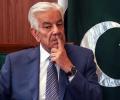
The entry of other Arab countries in the mutual defence deal between Pakistan and Saudi Arabia is not ruled out, Defence Minister Khawaja Asif has said, adding that 'doors are not closed' for such developments.

A meeting with Chinese President Xi Jinping on the sidelines of the SCO summit is being planned.

'America holds about 16% of IMF voting rights, giving it crucial influence over Pakistan's desperately needed bailout loans.'
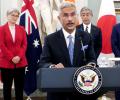
If the only superpower, which calls India an ally, sees the region through an India-Pakistan prism, it is unacceptable. Rather than endorse India's sphere of influence, this undermines it, asserts Shekhar Gupta.
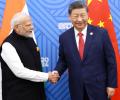
Chinese Foreign Minister Wang Yi said on Friday that India-China relations have made positive strides and achieved a series of encouraging outcomes at all levels after last year's breakthrough ending the over four-year-long military standoff in eastern Ladakh. Wang's remarks came during his annual press conference as he replied to a question on how Beijing views the course of bilateral ties after the two countries ended the prolonged stalemate in the ties.
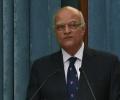
Former National Security Advisor (NSA) Shivshankar Menon has stated that the political dynamics between India and Pakistan have resulted in a "controlled level of hostility" that benefits the ruling elites in both nations. Speaking at the Kerala Literature Festival, Menon described Pakistan as a "brand new state" still grappling with its national identity. He argued that India's foreign policy towards Pakistan is influenced by its domestic politics, resulting in an uneasy equilibrium characterized by a "controlled level of hostility." Menon also questioned the concept of a multipolar world, stating that the current global order is merely "confused." He emphasized that the United States remains the world's true military hegemon, while other nations, including China, are regional powers. Menon further argued that there is no binding international order, leading to a state of "between orders." He highlighted the absence of definitive international agreements on crucial issues in recent decades.

Even in a banner year marked by achievements of the highest order across a wide variety of fields, it was inevitable that Dr Zakaria would be named India Abroad Person of the Year 2008. Filmmaker Mira Nair, who won the award last year, was on hand to honour her successor with the award that, over the seven years of its existence, has become one of the most sought after accolades in the community space
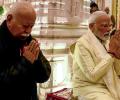
Much drama is likely to continue in the coming year, within the Sangh Parivar as well as involving the Opposition parties and, of course the BJP's allies, predicts Modi biographer Nilanjan Mukhopadhyay.

The National Security Strategy document should flag all major issues concerning security strategy and provide guidelines to concerned departments to work out suitable action plans. Since the global and regional geopolitical canvas is dynamic, the NSS document should be deliberated at length before formulation and should be reviewed periodically, recommends Commodore Venugopal Menon (retd).
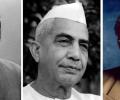
The government had earlier announced the country's highest civilian honour for L K Advani and Karpoori Thakur.

The ineptness of successive American presidents, from Bush the Younger to Joe Biden the Old, combined with the cluelessness that Americans demonstrate in foreign lands, contrasts with the Chinese leadership's seemingly singular focus on the accumulation of wealth and power, asserts T N Ninan.

India also went on an overdrive in expanding its military engagement with like-minded countries in its neighbourhood and beyond in the face of China's relentless attempts to become a regional hegemon and establish its primacy in South Asia.
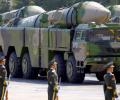
China is expanding its nuclear force and is likely to have a stockpile of about 1,500 warheads by 2035, up from the current estimated number of 400, the Pentagon has said in a report that notes that Beijing aims to expand its national power through both domestic and foreign policy initiatives.

Modi on the global stage always comes across as a statesman, counselling peace and amity to world leaders even as his policies at home hurt certain sections, explains Virendra Kapoor.
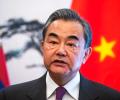
Addressing a symposium on the international situation and China's foreign relations in 2022, Wang said both countries have maintained communication through diplomatic and military-to-military channels.
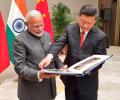
'In South Asia, unlike Southeast, East, or Central Asia, there is a natural hegemon: India. China cannot cast it aside easily'
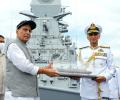
Taking a dig at China, Defence Minister Rajnath Singh on Sunday said 'some irresponsible nations' with their narrow partisan interests and hegemonic tendencies are coming up with wrong definitions of the UN Convention on the Law of the Sea.

This year saw no improvement in bilateral ties as India accused Pakistan of cross-border infiltration and re-activation of terror-launching pads near the LoC.

The United States will be the "first among equals" in a world not dominated by a hegemonic power as neither China nor India are likely to topple the American supremacy to create a new international order by 2030, the US intelligence believes.

There are clear signs that the party is re-starting its journey to relevance by going back to its core Panthic agenda, on the basis of which it was founded over a century ago, reports Sai Manish.
'The propagation of an absolutist narrative that shuts down any dissent is dangerous, irresponsible, and unbecoming of India's proud democracy.' 'The government must do better.'

The dispersion of global economic power augurs well for the role of ideas in policy-making.

By the year 2027, which marks the centennial of the founding of the People's Liberation Army, China will build a fully modern military, a goal that is in alignment with the national strength and will fulfil the future national defence need, state-run Global Times quoted Chinese analysts as saying.

This visit has ended on a vastly different note in comparison with Modi's previous visits. Call it a rebuke, call it a censure, call it a distancing from Modi, the sharp message would have gone home, observes Ambassador M K Bhadrakumar.

Coming ahead of the transition of power from Donald Trump's administration to President-elect Joe Biden's administration after the November 3 US presidential election, the detailed policy document highlights that China is undermining the security, autonomy and economic interests of many nations in the region.
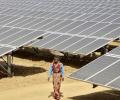
Arunabha Ghosh on why India will increasingly become an energy great power, but not an energy hegemon.

Only Bong Joon Ho -- whose film Parasite won the Oscars for Best Film, Best Director, Best International Feature -- knows how to work with a heavy hand and still get respectable results, says Ranjita Ganesan.

Neither Biden nor his successors can any longer ignore the threat China has come to pose to the US in both economic and military fields, observes Virendra Kapoor.
